Showing posts with label Disease. Show all posts

Friday, April 22, 2011

The Black Death...And the Bloody One

Plague is caused by Yersina Pestis. It's transmitted mainly by fleas and has a rodent reservoir...which means that plague's here to stay. If we can get rid of or vaccine EVERY SINGLE RAT ON THE PLANET, then sure we can get rid of plague.
Eventually.
On a brighter note, plague is becoming antibiotic-resistant!
Oh, that wasn't good. My bad.
Anyway, plasmids (DNA in circles instead of strands) containing the genes necessary for antibiotic immunity are frequently transferred to the plague bacterium in the flea midgut. Flea has resistant genes. Flea eats plague. Plauge gets resistant genes.
And in case you're worried, here are the symptoms!
Three to seven days after infection you become feverish, nauseous, and experience chills, fever, head/body aches, weakness and vomiting. In the most common form of plague, bubonic, the Yersinia pestis bacillus replicates in your lymph nodes, inflaming them to create "bubos".
These things hurt and sometimes burst, creating open, festering sores.
Isn't nature lovely?


And if that wasn't all, here's the bloody death to cheer you up!

Ebola is caused by an RNA virus. RNA is what came before DNA, but in this case, it does the same thing. It was first seen in Africa and causes illness in primates and humans. We don't know what the reservoir of the virus is yet, but there is strong evidence to suggest that it is an animal native to Africa.
The first infection (we think) results from contact with an infected animal. The next wave is when other people are infected. These people are usually the ones who care for the ill person i.e. their friends, parents, and/or doctors.
Just so you don't accidentally care for one of these unfortunates, here are the disputably worse symptoms!
After two to twenty-one days, headache, joint/muscle aches, fever, sore throat and weakness appear.
Isn't this sounding familiar.
Next comes vomiting (the similarities abound), diarrhea, and stomach pain. In some patients, rashes, red eyes, hiccups and internal/external bleeding is present. Death can be caused by "bleeding out"; this is when the internal organs disintegrate into blood and leave the body through any orifice. It's not understood why some people recover and others do not, but it has been observed that those deceased had very few antibodies in their bloodstream...Ebola attacks quickly.

And now that we've outlined the symptoms, which would you prefer? The black death...or the bloody one?

-[Asian X]

Friday, March 11, 2011

How It Really Gets To You - Anthrax

In 2001, terrorists attacked. Their weapon of choice? Anthrax. Almost a decade later, the anthrax mail attack is still foremost in people’s minds when they think of bioterrorism. But what is anthrax, really?

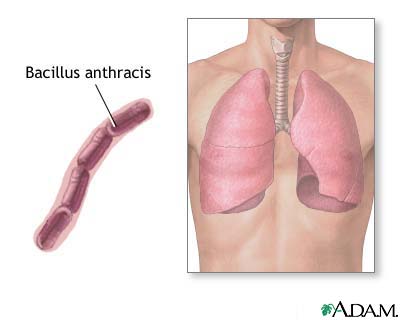
Anthrax is a rod-shaped (bacillus) bacterium formally known as Bacillus anthracis [See figure 1]. It is a part of the cellular organisms domain, specified into the bacteria kingdom, part of the fermicutes phylum, of the bacilli class, subdivided into the bacillales order, further specified into the bacillaceae family, then divided into the bacillus genus and finally identified in the bacillus cereus species.

Bacillus anthracis is endemic (native) to Asia, southern Europe, sub-Sahelian Africa and parts of Australia. It is found in soil, where its spores can last for generations. It mainly affects cattle, sheep, goats, camels, horses, and pigs in addition to the humans who care for them.

Anthrax is a lethal disease. Even though it doesn't cause your brain to explode, it's just as deadly. After being introduced into the body, the bacteria produces three compounds known as lethal factor, endema factor and protective antigen. Alone, lethal factor and edema factor are harmless, but with the addition of protective antigen they become deadly. Protective antigen binds to cell receptors, which then cut the protein in half. The halves bind separately to each of the factors, transforming them into lethal toxin and edema toxin. The two toxins each stop cell regulation via the signaling pathways, which results in cell death due to either necrosis (premature cell death) or apoptosis (cell suicide). Anthrax especially targets the immune system and blood vessel linings most likely because they require either downstream ERK activity or Mek1/2 pathway in order to reproduce. This mass cell death eventually results in either death by infection (the immune system's down) or death by lack of functioning (the cells are dead and therefore cannot perform any more).

Evidently, anthrax is nothing to be taken lightly. In 2001 this was shoved home as twenty-two people were infected. Although only five died, it was still a shell shock to the American society. Anthrax was the unanimous super-villain. Now, as people everywhere learn more about anthrax, they are able to fully appreciate the risks-whether they be large or small.


Figure 1 (Bacillus anthracis: MedlinePlus Medical Encyclopedia Image)


Read More

Wikipedia's article. Read this first, then the rest of the stuff...it'll make a LOT more sense, I promise

Click here for the effects, in all their pseudo-gory detail, of lethal toxin and edema toxin.

More lethal toxin and edema toxin effects here. It's a lot simpler and there's a link to the rest of the article for free!

Oh, wait. They're all like that.

And now, on to the World Health Organization. Here they are.

Last but not least, our lovely Centers for Disease Control. They had to work hard after that mailing...and here's the evidence.


Anyway, that was this week's episode of How It Gets To You. Stay tuned throughout the year to (maybe) hear about more!

(Unless, of course, this is offensive. In that case I apologize and sincerely hope that you spell your criticizing comments right)

-[Asian X]

Tuesday, March 8, 2011

Damaged Life...Or Death?


The Nipah virus.


Sound unfamiliar? That's because it is. In 1999, the virus was officially recognized during an outbreak among Malayian pig farmers. Although rare elsewhere, in Bangladesh the fatality rate is approximately 75%. The survivors aren't much better; 20% suffer neurological damage in return for their lives. A fair trade?
The survivors can suffer from convulsions and personality changes as well as recurrent brain swelling.

So. The real question here. Would you rather live a damaged life or die?
It's not a certainty that you'll suffer seizures. It's not a certainty that you'll suffer personality changes. It's not a certainty that you'll be affected. But this isn't all about you. Unless you’re living in India near pigs or bats, you’re pretty safe, unlike the people of Bangladesh. They have to live with this everyday.

And now we’ve gotten to the best part. So you know how I said India’s not the place to be?

I lied.

Well, not exactly. Viruses change extremely fast; take HIV for example. It changes from person to person (so if person A gives it to person B, person A and B do not have the exact same virus. Similar enough to be classified as the same, yes, but not the same). Nipah virus presumably has a fairly low transmission rate (Otherwise, a LOT more people would be dead), but that is subject to change at any time. In other words, this virus could spread across the globe.

The Spanish flu did the same. In 25 weeks, it’d killed 25 million people. Nipah virus would be much, much worse. The mortality rate for the Spanish flu was, at worst, 25%. The mortality rate for Nipah virus is 40-75%, easily twice that of the Spanish flu.

As of yet, there is no vaccine. We’ll just have to watch and wait...and hope our immune systems learn fast.


Read More

Click on the image for the World Health Organization factsheet and here for Wikipedia's henipavirus page (The link'll take you to the Nipah virus section).


Anyway, that was this week's episode of How It Gets To You. Stay tuned throughout the year to (maybe) hear about more!


(Unless, of course, this is offensive. In that case I apologize and sincerely hope that you spell your criticizing comments right)


-[Asian X]